
Is Audiodisplayed a technical term?

The word Audiodisplayed can look like a technical term because it combines two concepts: audio and display. However, whether Audiodisplayed is actually a technical term depends on how and where the word is being used. In most situations, it is not a widely recognized technical term in fields such as computer science, audio engineering, telecommunications, or web development.
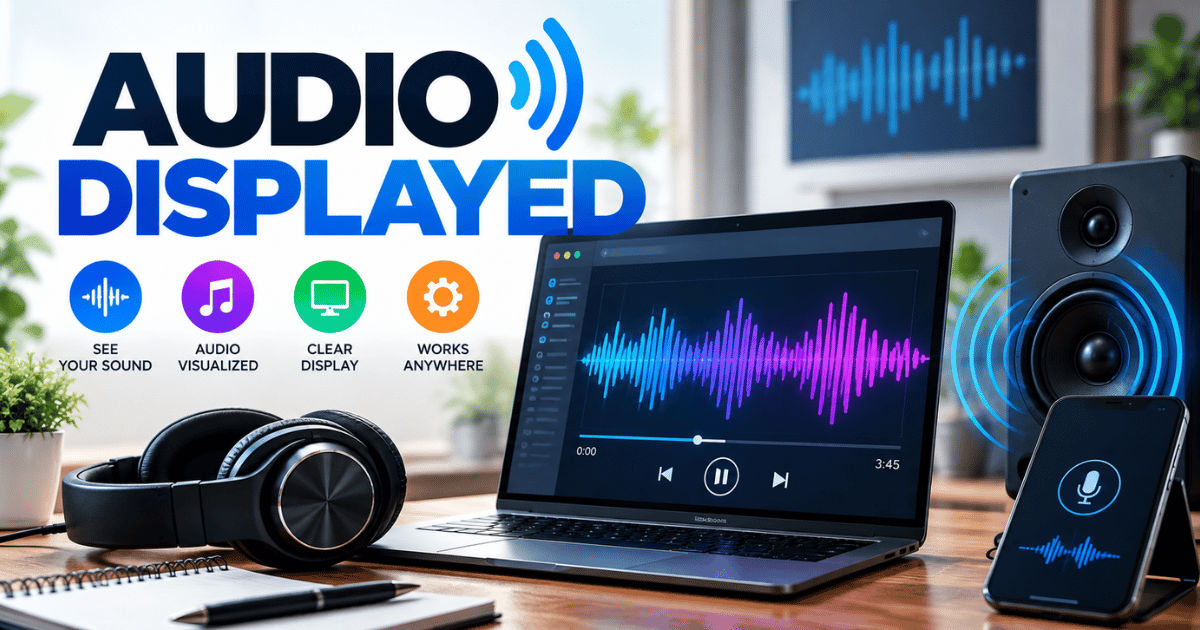
Understanding the difference between a genuine technical term and a descriptive word is important. Many words used in technology sound technical simply because they describe a digital process. Audiodisplayed may be one of those expressions.
This guide explains what Audiodisplayed means, whether it qualifies as technical terminology, where you might encounter it, and how to understand it when it appears in digital content.
What Does Audiodisplayed Mean?
The most straightforward way to understand Audiodisplayed is to look at its two parts: "audio" and "displayed."
Audio refers to sound. It can include spoken words, music, recordings, sound effects, podcasts, alerts, or any other form of recorded or transmitted sound.
Displayed means that something is presented or shown to a user. In digital technology, information can be displayed through a screen, interface, application, website, or another visual system.
When these ideas are combined, Audiodisplayed can be understood as describing audio that is presented, shown, represented, or made available through a digital interface.
However, the exact meaning can change according to context. A website developer, software application, accessibility system, or media platform could potentially use the word differently.
Is Audiodisplayed a Standard Dictionary Term?
Audiodisplayed is not generally recognized as a standard, established technical term in the same way as terms such as "audio codec," "sampling rate," "bitrate," or "digital signal processing."
Established technical terminology normally has a relatively specific meaning that professionals in a particular field understand.
For example, "sampling rate" has a defined meaning in digital audio. It describes how many samples of an analog audio signal are taken per second when converting it into digital form.
By comparison, Audiodisplayed does not have the same level of standardized technical definition.
This distinction matters because a word can appear in software, online content, metadata, or technical documentation without being an officially recognized term within the wider technology industry.
Why Does Audiodisplayed Sound Technical?
One reason Audiodisplayed may sound technical is its structure.
Technology frequently creates compound words by combining existing concepts. Examples include "audiovisual," "audio-enabled," "screen reader," and "voice-controlled."
Because Audiodisplayed combines an audio-related word with an action associated with digital interfaces, readers may naturally assume that it represents a specialized technology.
The appearance of a word can influence how people interpret it.
For instance, developers often use compact labels for buttons, variables, events, database fields, or system functions. A term such as Audiodisplayed could therefore look like a programming-related expression even when it is simply a descriptive label.
Technical-Sounding Does Not Always Mean Technical
A technical term normally belongs to a recognized area of knowledge and has a specific meaning within that area.
A descriptive expression does not necessarily have those characteristics.
For example, "video displayed" is understandable English, but it is not automatically a technical term. It simply describes the fact that a video has appeared on a screen.
Similarly, Audiodisplayed may describe an action or state rather than identify a particular technology.
This is an important distinction when reading websites, software interfaces, or technical documents.
Could Audiodisplayed Be Used in Software?
Yes, a word such as Audiodisplayed could potentially be used inside software.
Developers regularly create names for variables, events, functions, database fields, and interface elements. These names are often based on what an object or action represents.
For example, a developer might create an internal variable indicating whether an audio element has been presented to a user.
In that situation, Audiodisplayed could function as an internal identifier.
That would not necessarily make the word a standardized programming term.
Audiodisplayed as a Variable or Event Name
Programming languages allow developers to create identifiers according to specific naming rules.
A developer might use a name such as audioDisplayed to represent a true-or-false value.
The value could indicate whether an audio clip has already been presented or played.
In this context, Audiodisplayed would be meaningful within that particular software project. Another developer might understand the general idea from the name, but the exact behavior would need to be defined by the application's code.
This is very different from standardized terms such as "HTML," "API," or "JavaScript," which have broadly recognized meanings.
Is Audiodisplayed Related to Audio Technology?
The word may be associated with audio technology because of the word "audio."
Modern digital audio involves several technical concepts, including recording, encoding, compression, playback, streaming, synchronization, and processing.
A digital audio system may also interact with visual interfaces.
For example, a media player can display information about an audio file while the sound is playing. The interface might show a title, waveform, progress bar, album artwork, captions, or other information.
However, these technologies do not make Audiodisplayed a formal audio-engineering term.
Audio and Visual Interfaces
Audio and visual content often work together.
A podcast application might play spoken audio while displaying the episode title and artwork. A music application might play a song while showing lyrics and a progress indicator.
Accessibility software may also provide visual or spoken information to users.
These situations demonstrate why an expression involving audio and display can make sense in a technical environment.
Still, the specific word Audiodisplayed should be interpreted according to the context in which it appears.
Is Audiodisplayed a Programming Term?
It would be more accurate to describe Audiodisplayed as potentially being a programming identifier rather than a standard programming term.
Programming languages have formal concepts such as functions, variables, classes, objects, loops, arrays, and conditional statements.
A developer can give many of these elements custom names.
For example, an application might contain variables called audioDisplayed, audioPlayed, or audioLoaded. Those names are chosen by the programmer.
The name itself does not become an official programming concept simply because it appears in source code.
Why Developers Create Names Like Audiodisplayed
Clear naming can make software easier to understand.
A developer may choose a name that describes exactly what a variable represents. If a variable tracks whether an audio element has appeared in an interface, a name resembling Audiodisplayed could communicate that purpose.
Naming conventions differ between programming languages and development teams.
Some programmers use camelCase, producing audioDisplayed. Others might use snake_case, such as audio_displayed.
The capitalization and formatting can therefore provide clues about whether Audiodisplayed is being used as a programming identifier.
Is Audiodisplayed a Web Development Term?
Web development provides another possible context.
Websites commonly contain audio players, videos, interactive controls, animations, and accessibility features.
JavaScript can monitor events and respond when media changes state.
For example, a website could track whether an audio component has been shown to a visitor. A developer might create a custom variable or event to represent that state.
In this situation, Audiodisplayed could be part of a site's internal terminology.
That does not mean that web developers generally use Audiodisplayed as an official term.
HTML and Audio Elements
HTML includes standardized elements for embedding media.
The <audio> element is a recognized part of modern HTML. Developers can use it to provide audio content on webpages.
JavaScript can then interact with the audio element and respond to events.
The important point is that "audio element" is established web terminology, while Audiodisplayed would more likely be a custom expression if it appeared in a particular website's code.
How Should You Interpret Audiodisplayed?
The best approach is to examine the surrounding text.
Context usually reveals whether Audiodisplayed is being used as a technical identifier, a descriptive phrase, a label, or something else.
If you see it in source code, it may be a variable, function, property, or event name.
If you see it in a user interface, it could be a label or status indicator.
If you see it in an article, it could simply be a descriptive expression created by the writer.
Therefore, it is risky to assign one fixed definition to Audiodisplayed without knowing where the word came from.
Look at the Words Around It
Suppose Audiodisplayed appears next to terms such as "event," "variable," "function," "boolean," or "JavaScript."
That would strongly suggest a programming context.
If it appears alongside terms such as "speaker," "recording," "playback," or "sound," it may relate more broadly to audio content.
If it appears on a website alongside buttons or interface elements, it could describe a user-interface state.
The surrounding information is often more useful than the word itself.
Audiodisplayed vs. Established Technical Terms
It helps to compare Audiodisplayed with recognized terminology.
"Codec" is a technical term referring to technology used to encode and decode digital media.
"Bitrate" is a technical term describing the amount of data processed or transmitted per unit of time.
"Latency" is a technical term describing a delay between an action and its corresponding response.
"Audio displayed," however, is not comparable in terms of standardization. It describes an action or condition rather than identifying a specific technical concept.
This comparison shows why Audiodisplayed may be technical in context without being a formal technical term.
Can Audiodisplayed Become a Technical Term?
Language changes constantly, especially in technology.
A word that begins as an internal label can eventually become widely used if enough people adopt it.
However, widespread recognition usually requires consistent usage.
If different developers or organizations use Audiodisplayed to mean different things, it is unlikely to develop into a precise technical term.
For a term to become genuinely useful in technical communication, people generally need to understand what it means without requiring extensive explanation.
At present, Audiodisplayed is better treated as a context-dependent expression unless a specific system defines it differently.
Why Context Matters So Much
Technical language is highly dependent on context.
The same word can have different meanings in software development, electronics, telecommunications, media production, and everyday conversation.
A developer might use Audiodisplayed as an internal label, while a content writer might use it simply to describe audio appearing within an interface.
Neither usage automatically establishes a universal definition.
This is why technical documentation should define unusual terminology clearly.
If an application uses Audiodisplayed as a specific event, its documentation should explain exactly what triggers that event and what happens afterward.
Common Misunderstandings About Audiodisplayed
One common misunderstanding is assuming that every unusual technology-related word is an official technical term.
That is not the case.
Software contains countless custom names created by individual developers and organizations.
Another misunderstanding is assuming that a compound word must have a standardized meaning.
Technology frequently produces new combinations of ordinary words. Some become established terms, while others remain limited to a particular project.
It is also important not to confuse Audiodisplayed with related concepts such as audio playback, audio streaming, or audio visualization. These are separate concepts with their own meanings.
How to Decide Whether Audiodisplayed Is Technical
A simple test can help.
First, ask whether the word has a defined meaning in a recognized technical field.
Second, check whether professionals commonly use it.
Third, determine whether technical documentation gives it a specific definition.
Finally, examine whether the word appears as a custom name inside software or a particular platform.
If Audiodisplayed only appears in one website, application, or codebase, it is probably project-specific rather than a universal technical term.
If reliable technical sources consistently define it and use it in the same way, then it may have a stronger claim to being technical terminology.
Conclusion
So, is Audiodisplayed a technical term?
Generally, Audiodisplayed should not be considered a widely standardized technical term. It is more likely to be a descriptive expression or a custom identifier used in a particular technical environment.
The word can certainly appear in technology-related contexts. Developers might use a similar expression for a variable, event, property, or interface state. Websites and applications may also use it to describe what happens to audio content.
But simply appearing in software does not make a word an official technical term.
The distinction is important because technical terminology normally has a stable, recognized meaning within a particular field. Audiodisplayed does not appear to have that same level of universal standardization.
The safest way to understand Audiodisplayed is therefore to consider its context. Look at the surrounding words, identify the software or platform where it appears, and determine whether that system gives the term a specific definition.
If it appears in programming code, treat it as a possible custom identifier. If it appears in ordinary writing, it may simply describe an audio-related display action. If it appears in technical documentation, check how the document defines it.
In short, Audiodisplayed can sound technical and may be used in a technical setting, but that does not necessarily make it a formal technical term. Its meaning is largely determined by the environment in which it is used.
Understanding this difference is useful when reading unfamiliar technical language. Not every unusual word needs to be treated as a complex concept. Sometimes, the simplest explanation is the correct one: the word is simply describing what a system does.