
Commercial LED Strip Lighting vs Old Fluorescent Strips: A Retrofit Cost Breakdown

The pitch for replacing fluorescent strip with commercial LED strip lighting always sounds the same: half the energy, five times the life, pays for itself in two years. 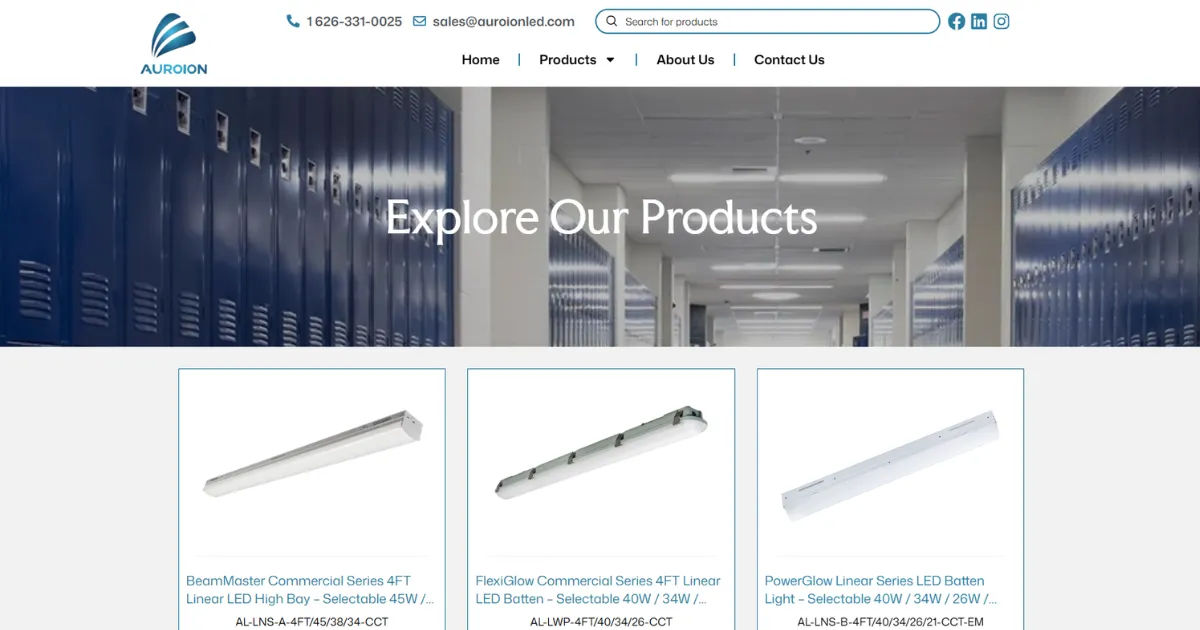 Facility managers have heard it enough times to be sceptical, and they’re right to be, because the two-year figure only holds under a particular set of conditions.
Here’s the arithmetic with the assumptions visible.
The Baseline: What You’re Actually Running
A typical 4-foot two-lamp T8 fluorescent strip with an electronic ballast draws about 59W total — 32W per lamp plus ballast losses. Older T12 units with magnetic ballasts draw closer to 86W for the same light output, and if your building still has them, you are the best retrofit candidate in the country.
Run 150 of those T8 fixtures 10 hours a day, 250 days a year: 2,500 hours annually, 22,125 kWh, roughly $2,655 at 12 cents per kWh.
The Replacement
A 4-foot LED strip producing comparable output — around 4,000 lumens — draws 30-32W. Same 150 fixtures, same hours: 11,625 kWh, about $1,395. Annual energy saving: roughly $1,260, or 47%.
That’s the number everyone quotes. Now the parts they leave out.
Cooling Load and Demand Charges
Every watt of lighting becomes heat your HVAC has to remove. In a conditioned space, cutting 4kW of connected lighting load typically knocks another 8-12% off the lighting energy saving in reduced cooling. On the 150-fixture example, call it another $110-150 a year.
Demand charges matter more in some tariffs than the kWh saving does. If your utility bills on peak kW and your lighting runs during peak windows, a 4kW reduction can be worth several hundred dollars a year on its own. Pull your last 12 bills and check the demand line before modelling anything.
Maintenance: The Saving Nobody Models Properly
T8 lamps last 20,000-30,000 hours and lose 10-20% of output before they die. At 2,500 hours a year, that’s a relamp cycle every 8-12 years for the lamps — but ballasts fail sooner and unpredictably, and each failure is a service call.
The real cost is labour. A two-person crew with a lift servicing warehouse fixtures runs $150-250 per call in most US markets, and the call is rarely for one fixture. Facilities running 150+ fluorescent fixtures typically log 8-15 lamp and ballast interventions a year. At $180 average, that’s $1,440-2,700 annually that disappears almost entirely with LED.
Add that to the energy saving and the picture changes considerably.
The Install Cost
Three approaches, three price points:
Full fixture replacement. $60-140 per fixture in product plus $50-90 in labour. Cleanest result, best photometrics, longest warranty. This is what I’d recommend for anything older than 15 years.
Retrofit kit into existing housing. $35-70 in parts plus $40-70 labour. Reuses the housing and reflector. Fine if the housings are in good condition and the reflector geometry suits forward-throwing LED.
Ballast-bypass tubes. $8-20 per tube. Cheapest, and it shows. You keep an ageing housing, an ageing socket, and photometrics designed for a 360° source. Sockets are the usual failure point within 3-5 years.
Rebates Change Everything
DLC-listed commercial LED strip lights attract utility rebates in most US territories, commonly $15-45 per fixture, occasionally more for DLC Premium products with controls. On 150 fixtures at $30, that’s $4,500 off the project cost — frequently a third of the total.
Rebate programmes have budgets and deadlines, and they get less generous every year as LED becomes the baseline rather than the upgrade.
So What’s the Real Payback?
For the 150-fixture example with full fixture replacement at $110 all-in, minus a $30 rebate: net project cost around $12,000. Annual saving of $1,260 energy plus $130 cooling plus a conservative $1,500 maintenance comes to $2,890. Payback: just over four years, with a 12-15 year asset life behind it.
Not two years. Still a good return, and considerably better than most capital projects competing for the same budget.
Auroion LED stocks commercial LED strip lighting for fluorescent retrofit projects in DLC-listed lumen packages that map cleanly onto existing T8 and T12 layouts.
Frequently Asked Questions
Is it worth replacing working fluorescent fixtures with LED?
Usually yes, once maintenance labour is counted. Fixtures older than 12-15 years are also approaching a wave of ballast failures, which means you’ll be paying for service calls on equipment you’re going to replace anyway.
Are ballast-bypass LED tubes a false economy?
Often. They’re the cheapest way to cut energy use, but you retain ageing sockets and housings and inherit reflector geometry designed for fluorescent. For a building you’ll hold five years or more, full fixture replacement usually costs less over the period.
How much energy does commercial LED strip lighting save over T8?
Roughly 45-50% at comparable light output, plus 8-12% again in reduced cooling load in conditioned spaces. Against older T12 magnetic-ballast fixtures, savings commonly reach 60-65%.
Do I need new wiring for an LED strip retrofit?
Rarely for the power feed — LED draws less current than what’s already installed. You will need new low-voltage control wiring if you’re adding 0-10V dimming or daylight harvesting, which is worth pricing at the same time.